Compare Bidet Efficiency Grades by Type and Grading Index
Key Takeaway
Bidet grades use one 1 to 5 scale across types, so compare the type, energy use per hour, and the efficiency grading index together. The agency list shows the first two; the index is on each detail page.
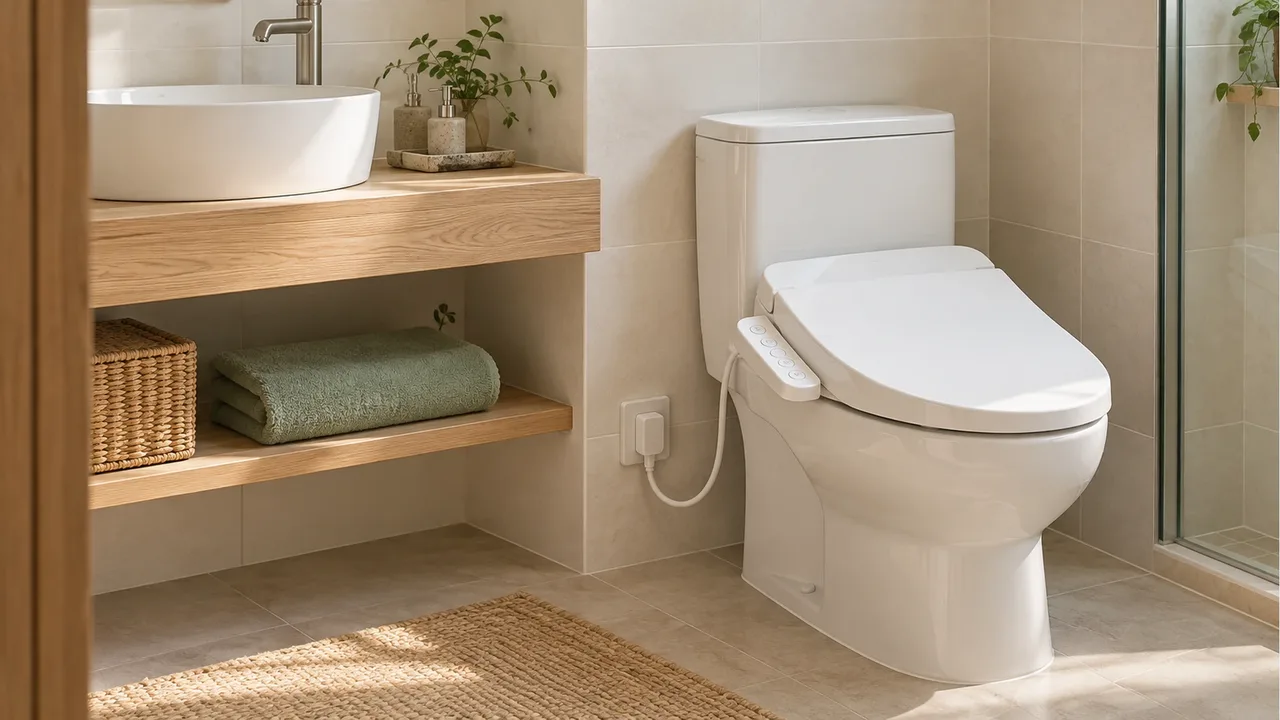
Which fields should I look at in the bidet list?
As of October 17, 2026, the bidet list in the agency's efficiency grade product search had 1,253 entries. The list shows maker, model, type, efficiency grade, and energy use per hour (Wh). Clicking a model adds automatic functions, the efficiency grading index, annual energy consumption (kWh), and annual energy cost (KRW).
The type is listed as instant, continuous, or tank. Even for the same bathroom, different types heat water differently, so matching the type first and then comparing numbers is less confusing.
Why can grades differ widely within the same type?
Because the difference in hourly energy use between models is larger than the difference between types. The five models below were copied from the agency detail pages on the same day.
| Model (maker) | Type | Energy per hour (Wh) | Grading index | Annual energy (kWh) | Grade |
|---|---|---|---|---|---|
| ASWS-7000 (Nanutech) | Tank | 18 | 0.411 | 157.6 | 1 |
| RB3700 (Ace Life) | Continuous | 18.4 | 0.419 | 161.1 | 1 |
| BAS50-A (Coway) | Instant | 23.2 | 0.53 | 203.6 | 1 |
| B358C (Xiaoyu Trading) | Instant | 29.2 | 0.666 | 255.6 | 2 |
| CIB3000 (Jeil Aqua) | Tank | 41.3 | 0.942 | 361.9 | 5 |
Values from the Korea Energy Agency efficiency grade product search, checked October 17, 2026.
Of the two tank models, ASWS-7000 uses 18Wh and is grade 1, while CIB3000 uses 41.3Wh and is grade 5. That is why the type name alone cannot tell you whether a bidet uses more or less electricity. The two instant models also split into grades 1 and 2 at 23.2Wh and 29.2Wh.
How do I read the efficiency grading index?
It is the index used to assign the grade, and among these five models a lower value came with a lower grade number: 0.411, 0.419 and 0.53 are grade 1, 0.666 is grade 2, and 0.942 is grade 5. How the index is calculated and where the grade boundaries sit are not shown on the list and detail pages checked, so this article does not give boundary values.
When comparing candidates, it is enough to check that the index moves in the same direction. Even within grade 1, a gap remains, such as 0.53 for BAS50-A against 0.411 for ASWS-7000.
What does the annual energy consumption field assume?
The agency page shows no formula, but the arithmetic points to a seat left on all day. 18Wh per hour times 8,760 hours in a year is 157,680Wh, about 157.7kWh, almost the same as the 157.6kWh listed for ASWS-7000. The same calculation for 41.3Wh gives about 361.8kWh, close to CIB3000's 361.9kWh.
This is only an arithmetic check of the table numbers against each other. Actual use at home changes with the seat temperature setting and power-saving functions. The annual energy cost on the detail pages (the estimated amounts for BAS50-A and CIB3000) also has no calculation conditions on the same page, so do not carry it over as a bill estimate.
Once you have candidates, what should you write down?
- Search the agency bidet list with the model name from the sales page or product label.
- On each detail page, note the type, hourly energy use, and grading index on one line per candidate.
- Among candidates with the same grade, mark the one with the lower hourly energy use and index.
The top of the agency list notes that grades can differ by manufacturing date and that the actual label may show a lower efficiency than the reported value. If you also want to understand standby power markings, see checking standby power markings. If a store product's label manufacturing date is earlier than the list completion date, match the label values again first.
Product information
Candidates compared
-
Coway Tornado Self-Care Bidet BAS27-D
-
Coway Compact Bidet 2.0 BA34-B
Product information is as of the date checked.
Frequently Asked Questions
Does a tank-type bidet use more electricity than an instant type?
The type alone does not decide it. In the October 17, 2026 list the tank-type ASWS-7000 used 18Wh per hour and was grade 1, while the tank-type CIB3000 used 41.3Wh and was grade 5.
Is a higher efficiency grading index better?
No. Among the five models checked, a lower index came with a lower grade number. The boundary values between grades are not shown on the pages checked.
How is the annual energy consumption calculated?
The agency page does not show a formula. For all five models, though, it is almost equal to the hourly energy use multiplied by 8,760 hours in a year, so it is safest to read it as a figure for a seat left plugged in all day.
Sources & Verification Date
- Korea Energy Agency Efficiency Grade Product Search — Bidets · Verified
- Korea Energy Agency Product Detail — Coway BAS50-A · Verified
- Korea Energy Agency Product Detail — Nanutech ASWS-7000 · Verified
- Korea Energy Agency Product Detail — Jeil Aqua CIB3000 · Verified
All materials have been verified from official announcements and may have changed since verification.