Check the Standby Power Marks on Products Before You Buy
This page contains Coupang Partners affiliate links; the operator may earn a commission.
Key Takeaway
Standby power is checked with the warning mark and the Energy Saving Mark. Covered products that miss the standard must carry the warning mark, and products that meet it can voluntarily carry the Energy Saving Mark.
The two marks only tell you whether the standard was passed. Check each product's standby power figure and capacity separately in the Korea Energy Agency product search.
What exactly is standby power?
The Operating Rules for the Standby Power Reduction Program define standby power as the power used while a product is merely connected to an external power source and is not performing its main function, or is waiting for a turn-on signal from outside.
The Korea Energy Agency's system overview explains that office and home appliances such as computers and monitors use power even in a standby state when not in use. It also says that if the plug is in, a certain amount of power is consumed even when the power is switched off. The same page says the energy cost wasted in standby time like this exceeds 10% of the power use of Korean households and the commercial sector, but this sentence gives no base year.
Which products get the warning mark?
It is mandatory on products that fail to meet the standby power reduction standard. The Korea Energy Agency says the purpose is to raise consumers' awareness. This mandatory labeling system was introduced in 2008, the first in the world, under the national roadmap "Standby Korea 2010," which targeted standby power of 1W or less.
The covered products widened over time.
- TVs from August 28, 2008
- Computers, monitors, printers, multifunction devices, set-top boxes, and microwave ovens from July 1, 2009
- Fax machines, copiers, scanners, video players, audio equipment, DVD players, radios, door phones, wired and wireless phones, modems, and home gateways from July 1, 2010
However, the Korea Energy Agency writes that it moved TVs, set-top boxes, monitors, computers, multifunction devices, and bidets to the efficiency grade system, and removed video players, modems, digital converters, and fax machines from the covered categories. Automatic power-saving control devices, hand dryers, servers, and wired and wireless routers are also excluded from the warning label system. Yet the category list in the product search still carries computers, monitors, multifunction devices, fax machines, modems, and digital converters, so that differs in part from this transfer and exclusion explanation. The list above is only the order in which the system widened, so to tell whether the product you want now is covered, look up the model in the product search and go by whether it is reported.
The operating rules require manufacturers and importers to finish measuring and reporting before sale, and to base the mark on the manufacturing date. They must report to the Korea Energy Agency within 60 days of being notified of the measurement result, and for a product that clearly misses the standard and will carry the warning mark, filing just the report without a test certificate is allowed.
What does the Energy Saving Mark mean?
The Energy Saving Mark is a voluntary mark that can be put on products that meet the standby power reduction standard. The operating rules call such products excellent standby power reduction products. It means a product among the standby power reduction covered products that has excellent reduction performance and conforms to the reduction standard.
For a manufacturer or importer to use this mark, it must receive a conforming result in a testing institution's measurement and report within 60 days of being notified of the result. Only products registered on the website by the chairman of the Korea Energy Agency, who receives the report, can be used in marking and advertising. There is also a follow-up rule that, if a registered product misses the standard or is falsely labeled, the Korea Energy Agency asks the Minister of Trade, Industry and Energy to take action.
This mark belongs to the standby power reduction program. The efficiency grade system that TVs and others were moved to, mentioned above, is a separate menu from the standby power reduction program within the Korea Energy Agency's Energy Efficiency Management System.
How do the two marks differ?
| Item | Standby power warning mark | Energy Saving Mark (excellent standby power reduction product) |
|---|---|---|
| Meaning | Misses the standby power reduction standard | Conforms to the standby power reduction standard |
| Nature of the mark | Mandatory | Voluntary |
| Applies to | Standby power warning mark covered products | Standby power reduction covered products |
| Reporting deadline | Within 60 days of notification of the measurement result | Within 60 days of notification of the measurement result |
| Mark reference date | Manufacturing date | Manufacturing date |
| Where to check | Korea Energy Agency product search | Korea Energy Agency product search |
Sources: Korea Energy Agency system overview and the Operating Rules for the Standby Power Reduction Program (version posted on the Korea Law Information Center, in force February 15, 2022). Date checked: 2026-10-07.
Where do you check when there is no mark or you're unsure?
In the Korea Energy Agency product search, you can look up all the products reported to the standby power reduction program. It tells you to check and compare each product's standby power and capacity, and notes that products that miss the standard carry a warning label, which you can use when buying.
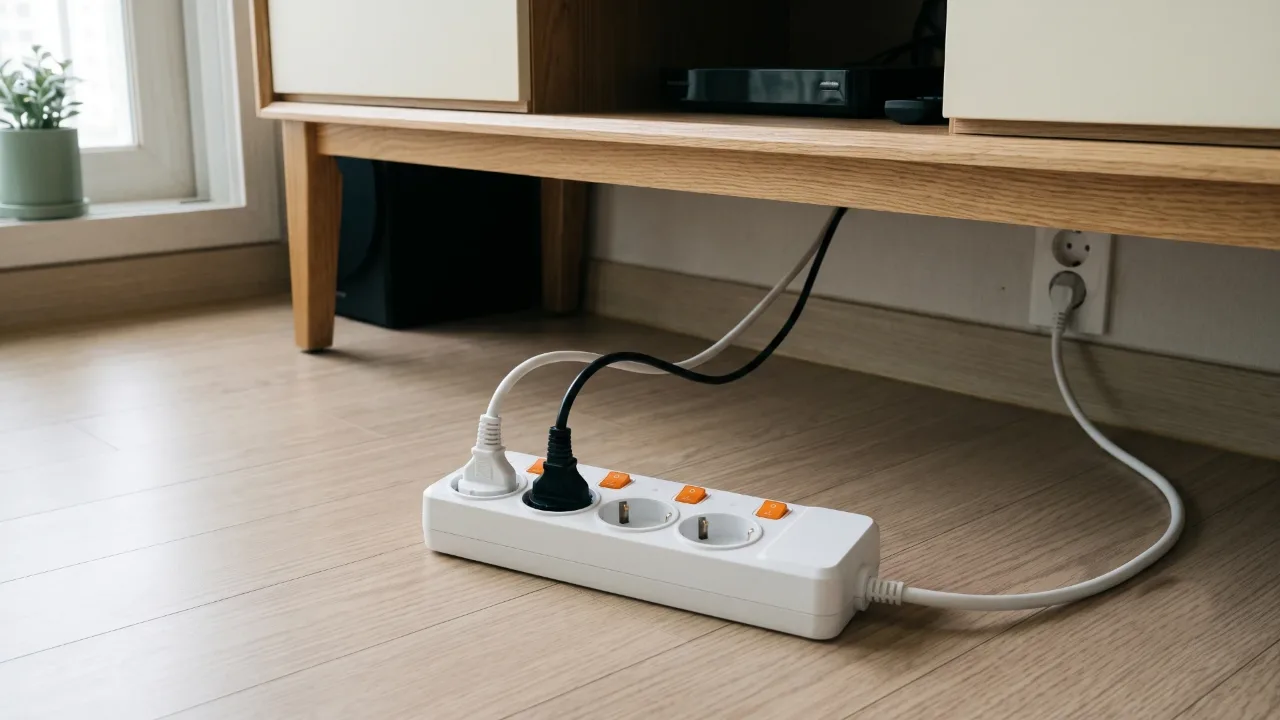
When buying a power strip, look at one more thing. In the Korea Energy Agency's scope notice, automatic power-saving control devices refer to power strips and standby-power-cutoff outlets that automatically cut standby power by sensing the operation of connected devices or ambient brightness, or on a set schedule. This category is not covered by the warning label system and is subject to a voluntary standard, so you can't judge the standby power level just because there is no warning mark.
- Look up the model name of the appliance or power strip you want in the product search to check whether it is reported.
- If the product carries a warning mark, compare its standby power figure with other models for the same use.
- If it has the Energy Saving Mark, check by model name whether it is a product registered with the Korea Energy Agency.
- Look at the manufacturing date too, because the mark is set by manufacturing date.
The Korea Energy Agency lists these rules as a Ministry of Climate, Energy and Environment notice, but the text that opens on the Korea Law Information Center is the version in force from February 15, 2022 (Ministry of Trade, Industry and Energy Notice No. 2022-33). Covered categories and standards can be revised, so before buying, go by the latest information on the product search screen.
Product information
Candidates compared
-
Hyundai Electric Domestic Power Strip, 6 Outlets, Individual Switches, 10m, 16A
-
Hyundai Electric Domestic Power Strip, 2 Outlets, Individual Switches, 3m, 16A
Check price and stock at the link. Product information is as of the date checked.
Frequently Asked Questions
If a product has no warning mark, is it a low standby power product?
You can't assume that. The warning mark is mandatory only on products among the standby power warning mark covered products that miss the reduction standard. A product without the mark may have met the standard or may not have been covered at all, so it's more accurate to check in the Korea Energy Agency product search whether the model is reported.
Can any product carry the Energy Saving Mark?
No. The Korea Energy Agency says products outside the notified scope can't be reported or carry the Energy Saving Mark and similar marks. The operating rules set it so that only products that received a standard-compliant result in a testing institution's measurement, were reported, and were registered on the Korea Energy Agency website may carry the excellent product mark.
Where do I see the standby power figure for each product?
In the Korea Energy Agency's Standby Power Reduction Program product search under the Energy Efficiency Management System, you can check and compare the standby power and capacity of reported products. The same page says products that miss the standard carry a warning label, and tells you to use that when buying.
Sources & Verification Date
- Standby Power Reduction Program Overview (Korea Energy Agency Energy Efficiency Management System) · Verified
- Standby Power Reduction Program: Scope and Technical Standards (Korea Energy Agency Energy Efficiency Management System) · Verified
- Standby Power Reduction Program Product Search (Korea Energy Agency Energy Efficiency Management System) · Verified
- Operating Rules for the Standby Power Reduction Program (Ministry of Trade, Industry and Energy Notice No. 2022-33, in force February 15, 2022, Korea Law Information Center) · Verified
All materials have been verified from official announcements and may have changed since verification.