Compare an electric blanket with a space heater by rated watts and eight-hour use
Key Takeaway
Electric blankets did not turn up in Korea's efficiency grade pages, so size up their power use from the label's watts and your hours. Convert watts to kWh, then compare with the consumer agency's eight-hour test.
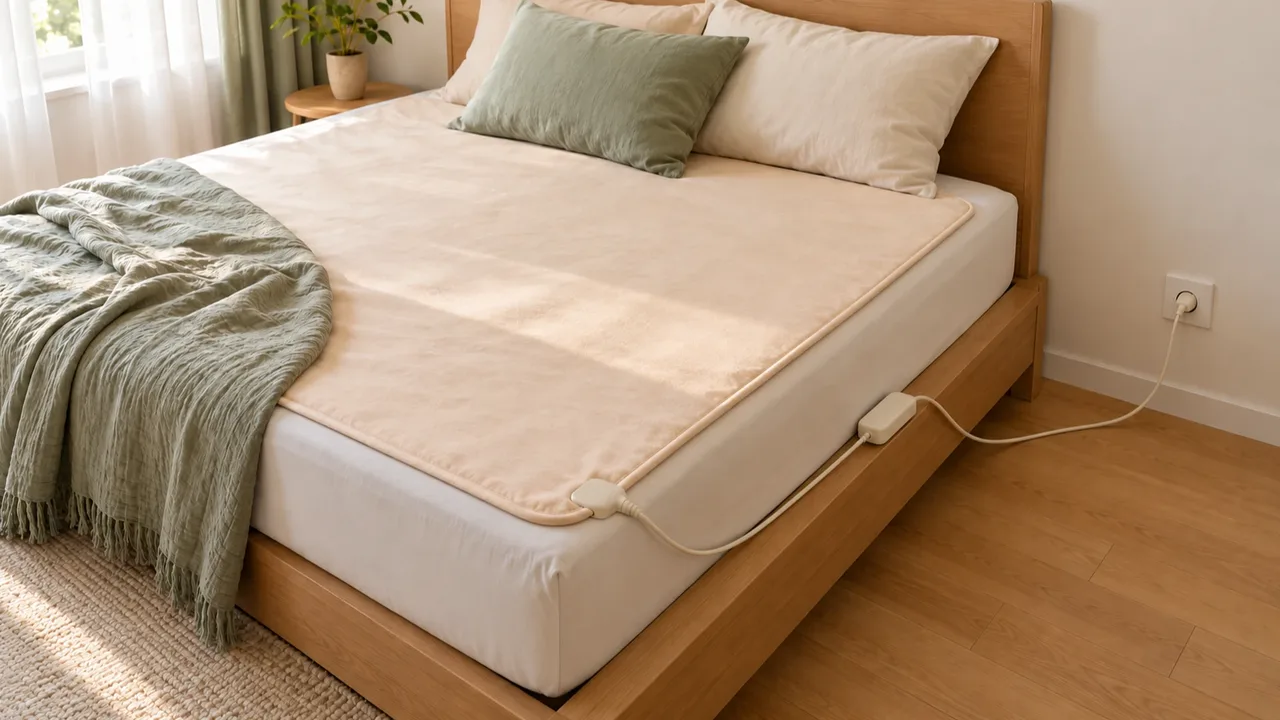
Do electric blankets carry an energy efficiency grade?
On the Korea Energy Agency's page on efficiency grade labels by product, checked on October 27, 2026, no entry mentions electric blankets, electric mats or heated pads. The page does not list every product, so this does not prove there is no grade. Once you have a model in mind, type its name into the agency's product search and see whether it appears. If it does not, the number to compare is the rated power in watts on the product label.
How do you turn rated watts into daily kWh?
Divide the watts by 1,000 to get kW, then multiply by the hours of use to get kWh. As an example, take the Shinil SEB-GSM100, whose official page lists a rated voltage of 220 V and power of 101 W.
- 101 W ÷ 1,000 = 0.101 kW
- 0.101 kW × 8 hours = 0.808 kWh
- 0.808 kWh × 30 days = 24.24 kWh
This is an arithmetic example that assumes the blanket draws 101 W for all eight hours. Apply the same assumption to an electric fan heater rated at 1,500 W and you get 1.5 kW × 8 hours = 12 kWh, or 360 kWh over 30 days. The two warm in different ways, so these numbers alone cannot say which feels warmer. The thermostat's on-off cycling and electricity rates are left out of the calculation.
How far can labeled power differ from measured power?
The Korea Consumer Agency webzine gives the tolerance as -20% to +10% of the labeled power. For a 101 W label, that puts the allowed range at 80.8 W to 111.1 W. In the agency's test published in December 2020, one of eight electric blankets exceeded this tolerance and broke the electrical product safety standard. So read the label's watts as a range.
How much did eight-hour use differ in the Korea Consumer Agency test?
The agency picked eight electric blankets by online purchase price as of October 2020. It ran each at its highest temperature setting for eight hours and measured energy use and average surface temperature. Energy use ran from 930 Wh to 1,503 Wh depending on the product, a gap of up to 573 Wh. 930 Wh is 0.93 kWh. Average surface temperature ranged from 48°C to 66°C, and the hotter surfaces tended to use more energy. The tested models were on sale in 2020 and may differ from what is sold now.
How do the two Shinil blankets differ on the official pages?
Both are Shinil electric blankets listed for sale under the same model name on Coupang Partners. The values below are only what Shinil's official product pages list.
| Item | Shinil Cotton Electric Blanket SEB-GSM100 | Shinil EMF Electric Blanket SEB-H110CP |
|---|---|---|
| Type | Cotton/microfiber blanket | TC electric blanket |
| Rated voltage | 220 V | Not listed on the page |
| Power | 101 W | Not listed on the page |
| Size (single) | 1,000×1,800 mm | 1,000×1,800 mm |
| Safety and care | 15-hour auto shutoff, hand washable | Not listed on the page |
The table reflects Shinil's official pages as checked on October 27, 2026. The SEB-H110CP page gives no power figure, so it could not go into this article's calculation. Check prices and stock through the links below.
Where can you look up safety marks before buying?
The Korea Consumer Agency advises searching the product safety information center (www.safetykorea.kr) by certification number or product name, using its certification and recall lookups, before choosing. The test standard it cites caps the heating element at 95°C and the surface in sleep (low) mode at 37°C. For use, the agency asks you to lay a thin sheet over the blanket, avoid latex bedding, and sleep on the lowest setting with the timer on.
What should you do if the product page leaves the power field empty?
Ask the seller's product information section or the maker's customer center for the rated power first. Once you have it, divide the watts by 1,000, multiply by eight hours, and write down your own kWh figure. When the blanket arrives, match it against the watts printed on the unit's label.
Product information
Candidates compared
-
Shinil Cotton Electric Blanket SEB-GSM100 (Single)
-
Shinil EMF Electric Blanket SEB-H110CP (Single)
Product information is as of the date checked.
Frequently Asked Questions
What range is allowed for an electric blanket labeled 101 W?
The Korea Consumer Agency describes the tolerance as -20% to +10% of the labeled power. Applied to 101 W, that gives 80.8 W to 111.1 W, which is an arithmetic example.
How many kWh does a 101 W electric blanket use in eight hours?
Assuming it draws 101 W the whole time, 0.101 kW times 8 hours is 0.808 kWh. The thermostat switches power on and off, so real use can differ.
Do electric blankets carry a 1 to 5 efficiency grade?
The Korea Energy Agency grade-system page did not mention electric blankets, electric mats or heated pads. Instead of expecting a grade, read the rated power on the product label.
Sources & Verification Date
- Korea Consumer Agency Consumer24: Electric blankets differ in temperature uniformity and power use · Verified
- Korea Consumer Agency webzine: A comparison test to read before buying an electric blanket · Verified
- Korea Energy Agency: Energy efficiency grade system, label information by product · Verified
- Shinil Electronics cotton/microfiber electric blanket SEB-GSM100 product page · Verified
- Shinil Electronics TC electric blanket SEB-H110CP product page · Verified
All materials have been verified from official announcements and may have changed since verification.